

How AI Is Transforming Daily Work in Service Teams
Reduce downtime and improve service efficiency with AI-powered troubleshooting. Learn how service teams use ilean to solve problems faster and capture knowledge.


Autodesk Inventor 2027 introduces new features focused on automation and efficiency, including enhancements to Content Center, new iLogic code blocks, and the AI‑powered Autodesk Assistant. In this guide, we highlight the key Inventor 2027 updates and how they support smarter, more efficient design workflows.
Autodesk Inventor 2027 leans heavily into AI and automation, with Autodesk clearly focusing on tools that reduce repetitive tasks and make it easier for designers and engineers to work smarter, not harder. The update includes improvements across the platform, from Content Centre enhancements to visual coding tools, and the introduction of Autodesk Assistant, an AI agent built directly into Inventor. Alongside these major updates come several smaller but genuinely useful additions, including a redesigned slot tool and better ways to work with point cloud data.
This article covers:
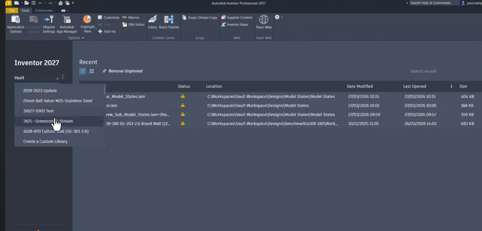
One of the standout updates is the ability to publish and use assemblies inside the Content Center. Until now, Content Center has been a library of standard‑driven part files like fasteners, fittings, washers, and components used in the Tube & Pipe and Frame Generator environments. With Inventor 2027, Autodesk has added a publish option that supports the use of assemblies in the content centre. It now becomes possible to store default assembly starting points, such as a core product that gets customised regularly or commonly reused purchased assemblies. The placement options remain familiar, allowing assemblies to be placed as standard or custom items. It’s a subtle change but one that gives Content Center a new relevance.
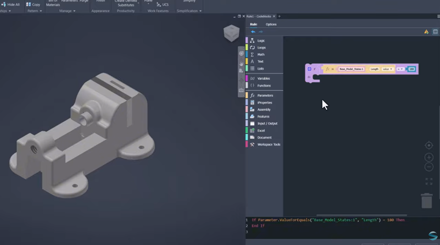
iLogic also receives a meaningful upgrade with the introduction of Codeblocks, a visual block‑based way of creating iLogic rules. This approach will feel familiar to anyone who has used Blockly or similar visual coding environments, making rule creation far more approachable for designers without a programming background. Codeblocks separate user input from model actions, improving readability and making rules easier to maintain. For teams building configurators or option‑driven models, the clarity and accessibility these blocks offer will likely encourage far wider use of iLogic across organisations. Importantly, the system still generates text‑based rules in the background, so experienced users don’t lose any flexibility.
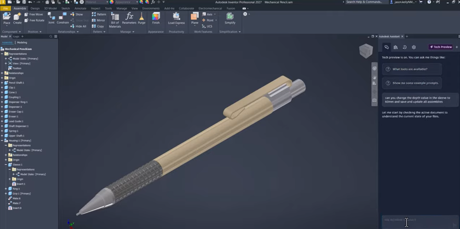
The most significant change to this release is Autodesk Assistant, the AI agent now built into Inventor and several other Autodesk products such as Vault, Revit, and Fusion. Rather than acting as a simple help tool, the Assistant can interpret natural‑language instructions and directly interact with the model. It can adjust iProperties, modify parameters, manage Model States, create PDF drawing packs, run iLogic rules, draft supplier emails. Because the assistant can access the Inventor API, many of the tasks users once had to script manually can now be triggered by a simple prompt. The tool also stores conversation history, making it easy to reuse prompts or create predefined commands.
Among the additional tools worth noting is the new slot feature. Slot creation is now more intuitive, using a modernised property panel similar to the hole command. Designers can define slot size, orientation, and placement more efficiently, and the feature works consistently across part and assembly environments. Slot annotations are also available in drawings, making the workflow more complete from design through to documentation.
Point cloud management has also been improved, offering smoother navigation and better control. Users can now create section views directly from point clouds, adjust point sizes through the navigator, align coordinate systems, and undo crop operations. Inventor 2027 also allows point clouds to appear on drawings, which makes documenting scanned environments significantly easier.
Alongside these headline features, the release also supports workflows like sketch‑driven assembly patterns, new options for managing assembly folder structures, and improved interoperability between Inventor and Revit. Altogether, Inventor 2027 feels like a focused, well‑rounded update that enhances automation, increases accessibility to advanced tools, and introduces AI‑driven workflows that will only get stronger over time.
To complement these new capabilities, it’s also a great time to take advantage of our training opportunities. Whether you're looking to deepen your expertise with Inventor or explore cloud-connected workflows in Fusion, we’re offering an exclusive 25% discount on any Inventor or Fusion training course booked before 1st June. When booking a training course on our website, please use discount code: AUTODESK27
This is also an ideal opportunity to learn how Sovelia Inventor can extend Inventor’s capabilities with powerful automation for documentation, property management and model updates, improving data consistency, and enhancing overall workflow efficiency. You can explore its full functionality by downloading a free trial.
If you have any questions please contact us .
Need help deciding whether you should upgrade to the Autodesk 2027 releases or need more help understanding how they can fit into your workflows? Get in touch below!
You can also call us on 0345 370 1444 or email info@symetri.co.uk
Reduce downtime and improve service efficiency with AI-powered troubleshooting. Learn how service teams use ilean to solve problems faster and capture knowledge.
The construction industry is entering a new era, and Bluebeam is once again leading the way. In 2026, Bluebeam Max will launch as a new premium subscription that combines the power of Revu with advanced AI technology. This blog highlights just some of features you will expect to see within Bluebeam Max.
In construction, the gap between the construction site and the office has always been a challenge. But by combining Bluebeam’s powerful PDF markup tools with GoCanvas’s mobile forms, companies can finally achieve seamless documentation that flows effortlessly from site to office.